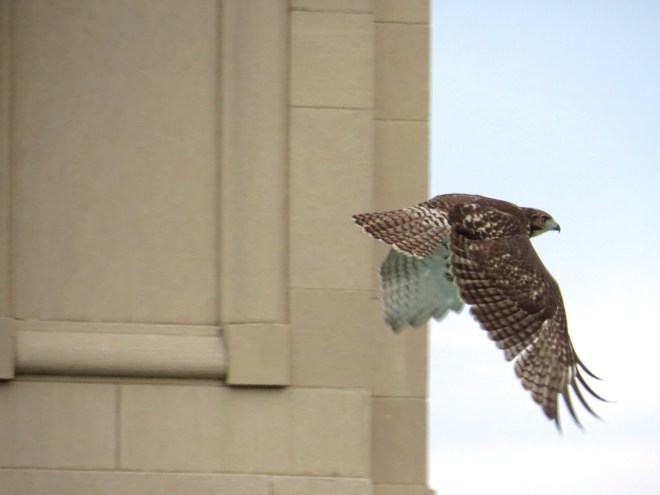
‘Cause I’m as free as a bird now,
And this bird you cannot change.
– Lynyrd Skynyrd
#freebird #tbt
#freebird #tbt
Since the young hawks have fledged, we’ve seen them hanging out on rooftops, fire escapes, and other structures around the church, usually at dawn and dusk. But there are days when the cross is empty and we don’t see any young hawk activity all day long…so a mystery presented itself: Where are they going?
“How often have I said that when you have excluded the impossible whatever remains, however improbable, must be the truth.” – Sherlock Holmes (The Sign of Four by Arthur Conan Doyle)
After we ruled out the possibility that they were summering in the Hamptons with Leonardo DiCaprio or flying by Pluto with New Horizons, we started to hunt for clues that might help us.
The first real clue came at dawn one morning when we saw one of the birds fly towards a grove of trees near the church.

The hawk didn’t emerge so we began a long, pain-staking camera pan of the trees nearby. After almost giving up, like a 49er in the Truckee river, we struck gold! See if you can find the barred tail…

So…we knew at least one hawk was perched in a tree. Then, later that afternoon, the hawks were flying/crying around hoping for a feeding. One of them flew right into the trees…

…then flew right back out!

Aha! So we now we knew we should check that area more thoroughly. No luck for the first hour or so, until we happened upon the second fledgling perched in a low branch!

It seemed quite comfortable in the tree, conducting its own detective work on a tiny leaf.


A group of pigeons sat just under the tree totally unfazed…a hint that the young hawks still aren’t hunting yet. The fledgling took off soon after.
We found nothing the next day. And we searched a lot.
‘Come, Watson, come!’ he cried. ‘The game is afoot. Not a word! Into your clothes and come!’ – Sherlock Holmes (from The Adventure of the The Abbey Grange)
Not to be deterred, we continued the search the next day. And, this time, the good old-fashioned footwork paid off. We spotted another fledgling!

It was quietly perched in a tree…investigating the intricacies of a branch.

The young hawk sat there for at least an hour, totally unnoticed by humans and animals alike.
And finally, just yesterday morning in a different area on 3rd Street, we could hear the loud cries of a hungry young hawk. Sure enough, there we found one.

It cried and cried nonstop, attracting a small group of human observers. It moved in the tree a bit.

Mom was on the church with food and Dad arrived and started calling, perhaps hoping to lure the young hawk closer with some food.

The fledgling flew to a fire escape closer to the church and began a back and forth calling session with Christo that lasted a good 30 minutes.

The young hawk argued and argued…

…but Dad won out in the end. The young hawk flew to a nearby rooftop to await a feeding.
And so the search continues…but we are reasonably sure that if the hawks don’t make it to Tompkins Square Park, they’ll start practice-hunting a bit closer to home.
“Education never ends, Watson. It is a series of lessons with the greatest for the last.” – Sherlock Holmes (The Red Circle by Arthur Conan Doyle)
You could tell there was something special in the air this morning when even the ConEd plant looked beautiful.

Birds of a different feather circled above…


…and Christo was perched on the church, ready to begin another day.

He let out a rousing call as he took off from the church, effortlessly gliding around the neighborhood.
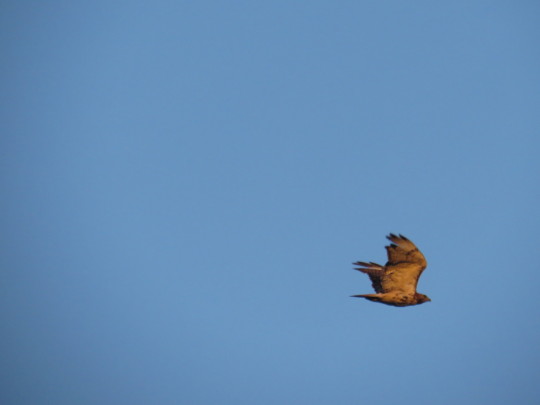
Then, as has become routine over the last week, from every direction, the young hawks flew in…

…circling above the rooftops of 3rd St. and Ave A…

…flying beautifully, higher and smoother than ever before.

They eventually landed near the church, calling back to their father that they were here and ready to eat.


As Dad went off to hunt, our hearts were warmed with the thought that all three young hawks are thriving. So far, they have overcome very tough odds (hawks have about a 20% chance of survival in their first year), but these young hawks are growing stronger every day.
A few hours later, just 2 miles down the isle of Manhattan as the crow flies, New York City celebrated another group that defeated all odds, and broke records! The “Canyon of Heroines” erupted with sheer joy honoring the amazing 2015 World Cup Champion US Women’s Soccer team (with an historic, first-ever NYC ticker-tape parade for a women’s team).
What a wonderful start to the weekend…
We have been so happy to receive lots of photos, videos, and questions from readers all around the neighborhood (and the world!). And then local businesses Downtown Yarns and Exit9 got into the hawk-spirit during #fledgewatch. But what we are about to show you is by far the BEST hawk-inspired work of art that we’ve received.
Alexi, a 5 year old recent Kindergarten graduate, lives very close to the hawks’ home base in the East Village. She has been able to watch them eat, fly, and explore their surroundings. The fledglings have even hung out on her family’s balcony!
Her whole family has been following their development. As Mom put it, “We are enjoying the experience of being near the Hawks.” We couldn’t say it better. But Alexi found a way to…she made a whole book!!


We urge you to go back and examine the detailed illustrations again, you’ll be delighted. Thank you so much, Alexi, for sharing your beautiful book with us. We look forward to keeping up with the hawks with you!
At 5:30am this morning, we caught up with two of the fledglings sharing a special sibling moment: a battle over a rat.
Sibling 1: Gee that’s a nice rat. Looks like we could split it and each take half.

Sibling 2: Not gonna happen.

Dad: Keep it down, kids. I’m gonna go hunt for more. Don’t hurt each other while I’m gone.

Siblings 1&2: Mine! No it’s mine! <tug of war ensues>

Sibling 2: Ha! I win! Better luck next time, sucker!

Sibling 2: <moment of remorse, looks back> Maybe I should bring it back and share?

Sibling 2: Nah. <swallows rat whole>

Sibling 1: I’m telling! Daaaaaad….

It’s hard to believe it’s only been 2 months since Dora and Christo’s first hatchling of this year emerged. We nostalgically look back at how quickly they’ve blossomed.
Here’s the middle child (we believe) eating a feather a month ago:
And now, just a month later, they are flying pretty well and starting to explore their surroundings…
…like a roof turbine vent (learned something new today!) in the wind…
…and a rooftop food drop (actually leftovers from the evening before). Watch how carefully the fledgling, which we believe to be the youngest/last, approaches. But it will get that food one way or another…
In case you missed it: what happened when a class of 4th graders in New Hampshire proposed changing the state bird to the Red-Tailed Hawk this past March? You have to see it to believe it, but we’re sure you’ll agree that John Oliver rocks.
On Sunday evening, I asked Gog if she had seen the Wayward Fledgling and she told me that all three fledglings were in the vicinity of the church. What wonderful news! We’ve been wishing that the whole family would be reunited and it happened, at least for a little while! We managed to catch photos of all 3 fledglings within a 50-yard radius of each other…


We still want to see all 3 together in the same frame, so we’ll be on the lookout.
We have seen the fledglings start to expand further from their home base around the church, exploring around 3rd and 4th St. One even flew to 1st Avenue before we lost sight of it. If you see a fledgling anywhere, please let us know! We’re hoping the worst shenanigans are over, and that soon, we’ll see them learning to hunt on their own.
Throughout our time blogging about these hawks, we’ve learned so many new things and we’ve heard a lot of stories – everyone has had some kind of experience with them. But we have also heard a lot of people quite confidently spouting misinformation. This is our attempt to break down some of that.
Myth #1: They are not Red-tailed Hawks.
Actual quotes we have heard:
The birds that often rest on the top of the cross on the Church of the Most Holy Redeemer on East 3rd St. are, without a doubt, Red-tailed Hawks.
Red-tailed Hawks (RTH’s) are very common throughout North America, largely thanks to their adaptability. That’s why they can thrive just as well on a mountain cliff as they can on an air conditioner.
Myth #2: They cause the rat problem in Tompkins Square Park.
Tompkins Square Park has, in the past, limited or suspended rat poisoning during fledge season. This is because RTH’s are a federally protected species. A good amount of the EV Red-tailed Hawks’ diet is rat (they also eat mice, squirrels, sparrows, starlings, and pigeons from what we’ve observed). While they probably make a decent dent in the rat population, especially feeding a family of five, the reality is that we humans are the reason rats are plentiful in the park. They eat our garbage. And unfortunately, we often make it easier for them by littering. That’s why the city has installed those rat-proof, solar-powered garbage cans. So, the best way to shrink the rat population wouldn’t be to drop tons and tons of poison around or to bring in 100 Red-tailed Hawks (even though that would be something to see), it’s actually just to throw our trash in a covered garbage can! If only we could all be as smart as this crow. If you want to learn more amazing facts about rats, check out Robert Sullivan’s book, “Rats: Observations on the History and Habitat of the City’s Most Unwanted Inhabitants”.
Myth #3: They nest in Tompkins Square Park.
Nope, they nest near the park but not in it. Last year, they nested on the Christadora building but got kicked out because of building renovation. This year, they nested on the 12th floor at Ageloff. It is illegal to tamper with a nest, and Red-tailed Hawks like to nest in the same place year after year so, with luck, they’ll be back again on Ageloff next year. For now, though, the nest remains empty.
Why have these hawks chosen to nest on buildings rather than in the park? One factor is likely having a higher vantage point for the nest. It’s easier to protect and also easier to see what’s going on from a building that’s taller than the highest tree in the park. Urban ecologists believe that it’s also because the parents might have been raised on buildings. Guess you go with what you know!
Myth #4: That’s not a baby!
When the Wayward Fledgling made a close encounter with people on 3rd St. last week, a lot of people didn’t believe that it was a mere 55 days old. “It’s way too big!” The good news is that we have been tracking every stage of these big babies’ growth and, while it has been astoundingly fast, we can assure you that these are the same birds. The easiest way to tell the juveniles from the parents is their tail. In young birds, the tail is barred, while in fully grown adults, it is a rusty red.
Myth #5: These birds shouldn’t be in the city. They have no place here. If you want to see wildlife, go to Jersey.
This is a real quote, and sadly we’ve heard versions of this more than once. To you, we say: You should rethink this, my friends. When you really start to look around the city, past the taxis and buses, past the fast-moving flow of urban foot traffic, past your own phone, you start to see that there is already so much wildlife around you. Cities are filled with all types of animals, including us, and we should all make an effort to understand that this is just as much their place as it is ours.
 TwoHawksNYC