Whooping Cranes: Us Saving Them Saving Us

It’s a story of destruction, redemption, and hope. It’s a story about the balance of all living things. It’s a story about some tall, shy, trumpet-sounding, mostly-white, beautiful birds who were brought to the brink of extinction by us…who are slowly being saved by us…and who may be saving us after all.

image

According to fossil records, Cranes have been around for about 12 million years (give or take a million).  They have inspired humans for generations; through folk tales and legends they have symbolized happiness, wisdom, longevity, and prosperity.  

Here in New York City, cranes symbolize prosperity too.  We see them every single day, extending their long necks to pick up bits of wood and steel off the ground and bring them to the highest heights. All kidding aside, construction cranes were actually named after the bird.  And, at 220 feet in height, New York City now has the tallest freestanding construction crane it has ever seen. Sigh.

image

Speaking of tallest, the Whooping Crane is the tallest flying bird in North America.  It stands at 4.5-5 feet tall with a wingspan of 7-8 feet (that’s the same or wider than Lebron James’ wingspan!).  This summer, when we heard about the Whooping Crane Festival in Princeton, Wisconsin, we jumped at the chance to learn more about this majestic creature.

image

As we drove from NYC to Wisconsin, we felt thrilled that we were going to see the rare Whooping Crane with our own eyes.  To hear its renowned Whooping call. To watch its elegant dance. To witness its slow, graceful step-by-step wading through still waters. There are only about 600 of these gorgeous Grus Americana in existence today and the chance to see one up close is an amazing opportunity.

Before humans populated North America, it is believed that Whooping Cranes were quite abundant, numbering about 15,000-20,000.  Their habitat ranged from Utah in the west to New Jersey in the east. By 1850, as people moved West and larger scale agriculture exploded, their population had decreased to about 1500. By 1941, due to continued habitat loss (wetlands being drained and repurposed for agriculture) and unregulated hunting (not just for meat, but as trophies especially as the birds became more rare), there were only 21 Whooping Cranes in existence.  To give you some perspective, that’s the same size as the Duggar’s nuclear family! We know who we’d rather see more of…

image

In 1967, Whooping Cranes were declared an Endangered Species (this is NOT required for the Duggars) and conservation efforts started in earnest.  Though many efforts in the past have failed (and they have been incredibly creative), conservationists have learned a lot and are starting to see great success. The Whooping Crane Eastern Partnership, a consortium of groups working to restore a self-sustaining, migratory population of Whoopers to eastern North America, details some of the efforts currently underway (including raising, training, releasing and monitoring).  

One of the founding members of the partnership is the International Crane Foundation, which is the only place in the world one can see all 15 species of cranes, 11 of which are endangered.  We got to visit them in Baraboo, WI.

From the Black Crowned Crane of Africa…

image

 to the Brolga from Australia…

image

…it’s easy to see why Cranes have captivated humans for so long.  But the biggest takeaway for us was a deeper understanding of the impact that the cranes’ habitat loss has on all of us. 

“Like a canary in the coal mine" as one of the Festival-goers stated, the demise of the Whoopers was a stark warning that we had been rapidly losing our marshes and wetlands.  Among other things, The ICF works around the world to restore wetlands in order to save all cranes (don’t miss their masterful video Cranes: Symbols of Survival, narrated by Tom Brokaw)…but the reality is that those habitats also play a vital role in human survival.  From the EPA: “…wetlands provide values that no other ecosystem can, including natural water quality improvement, flood protection, shoreline erosion control, opportunities for recreation and aesthetic appreciation, and natural products for our use at no cost.” 

So are we saving the Whooping Cranes or are they saving us? Turns out, the answer is both.

image
image

(this sign hangs at ICF near the Whooping Cranes)


In our next post, we go behind the scenes with Operation Migration.  In the meantime , pop some popcorn and check out their Crane Cam (on 24-7) to start get to know the 2015 class of six young whoopers. Warning: this is completely addictive!

This one’s for the Craniacs

The Whooping Crane Festival has wrapped up and we have so much to share that we’ll be breaking it into a multi-part series. As we migrate back to New York City, we’ve been reflecting on everything we learned and how inspired we have been. 

Before we get into the full story, we’d like to dedicate this poem to the Operation Migration team and all the Craniacs out there.


White Marsh Dawn

The fog hangs low in pockets, still,
The sun a line behind the hill,
The crows snack roadside, get their fill,
The morning breathes a sigh.

image

And in the marsh, hear life’s refrain,
The birds, the bugs, the critters reign,
No wind, no rain, good day to train,
It’s time to take the sky.

image

Tumes and Wellies* on, can’t be late,
Trike’s in sight, we’ve got a date,
Whoopers, eager, peck the gate,
They just can’t wait to fly.

image
image

The trike’s a go, the whoopers free,
They rumble tumble out with glee,
They run, they jump, and whoop whoopee,
No time for a goodbye.

image
image

From down below, we see them soar,
They slide, they glide, first aft then fore,
They form a line and flap no more,
Fly low and then fly high.

image
image

And now the sun is glowing bright,
As man, machine, and crane take flight,
Through grit, invention, and pure might,
All odds we can defy.

image

Weather permitting, the 2015 class of 6 young Whoopers will start their guided fall migration this Sunday, September 20. More from us soon as well.

*Tumes and Wellies = the white cosTUME and Wellington boots that Operation Migration folks wear when they work with the cranes. 

Whoop whoop!

We temporarily traded the big city for the open country to whoop it up at the annual Whooping Crane Festival in Princeton, Wisconsin. There is no better way to see the great work being done by Operation Migration and the WCEP. It is truly breathtaking. 

 Some photos from this morning’s training flight just after dawn:

Don’t worry, you won’t have to crane your neck…we’ll be bringing you more on this story so keep your hawk eyes open. 

A Very Temporary Hawk Exhibit at the Metropolitan Museum of Art starring Pale Male’s daughter

Hawk-tivity in the East Village has come to a near standstill as Gog pointed out earlier this week. So we ventured back up to Central Park this week to follow up on Pale Male and Octavia’s recently rehabbed and released fledgling (see WINORR releasing the bird, photos by Jean Shum, video by Cathy Weiner).

According to hawk watchers in Central Park, the bird has been on a bit of a cultural tour of 5th Avenue this week.  She spent time outside the Metropolitan Museum of Art, waited in line to see the Woman in Gold at the Neue, and even checked out the Kandinsky’s at the Guggenheim.

After a couple of days with no sightings, we got word that the hawk was back along the northern edge of the Met at 86th St. and 5th Ave. For hours, the hawk put on a live show for spectators, joggers, and dogs alike.  

While visitors were dazzled just to see the hawk so closely, it turned out that she was doing a one-time-only, live, interpretive performance of pieces in the Met’s collection.

We are proud to bring you the highlights of her show.  

image
image
image
image
image
image
image
image
image
image

Art references (in order of appearance):

1. Inlay of “Horus of Gold”, 4th century B.C., Egypt

2. Banda Mask, 19th–20th century, Baga peoples; Guinea

3. Finial in the Shape of a Bird’s Head, 4th century B.C., Northwest China

4. “Butterfly” stool (model no. T–0521), 1956, Sori Yanagi 

5. Outermost Coffin, spring 1926, Harry Burton

6. Fan quilt, ca. 1900, American

7. Alabama Tenant Farmer Wife, 1936, Walker Evans

8. “Butterfly” ball gown, 1955, Charles James

9. Study of a Young Woman, ca. 1665–67, Johannes Vermeer

10. Bird I, 1986, Santiago Calatrava

          Congratulations and thank you to the lovely newlyweds!

image

Vulture Populations Wane, Poisoned by Man

Troubling: African vulture population decimated by poachers’ poison. Damage to entire ecosystem will be likely result.
The Peregrine Fund thank you for your work on this!

Vulture Populations Wane, Poisoned by Man

Pale Male’s offspring treated & released back into Central Park

Great news from yesterday… WINORR released Pale Male’s now-healed fledgling back into Central Park after 2 weeks of treatment and care.  See their Facebook page for photos and video of the release. 

Where my babies at?

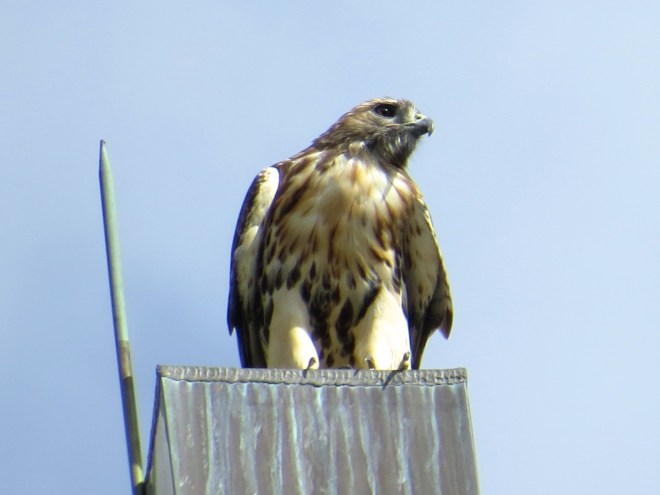
It’s been harder and harder to locate Christo and Dora’s young lately. While it’s common at this time of year for young hawks to start exploring on their own, we keep looking for them to see how they’re doing.

So, in addition to hitting the streets of the East Village and scanning the area like the NSA going through AT&T’s data we’ve been keeping an eye on Christo and Dora.  On a recent afternoon, we found them together on the dome of the Most Holy Redeemer Church on 3rd St. They look quite haggard as they are molting but they are still quite active even in the summer heat.

On this day, they were monitoring their territory and perhaps checking in on a baby, although it’s hard to tell. First, they “chatted” on the Church…

image

…then Dora took off, swooping East a bit and eventually circling West.

image

Christo watched her fly for a moment…

image

…then took off himself on the same East-then-West path.

image

They regrouped on top of the Village View tower where we’ve been seeing at least one of them almost every day lately.

image

One of them started hovering, looking directly down just in front of the building they were perched on.

image

It’s not clear what it was looking for, we were hoping a baby was nearby.  We scanned the entire area to no avail. There was a report a few weeks ago of a baby stuck in the construction netting on the school nearby but it apparently freed itself, thankfully.

Christo continued to stand on different parts of the same tower to look around (this is behavior we haven’t seen before on Village View)…

image
image

After a bit, Dora took off and a few minutes later Christo took off uptown.

image

Half an hour later, Dora was back on the Church dome and Christo on Village View.

image

She noticed something and headed off quickly – in the direction of…take a guess!

Village View.

image

She landed there gracefully, meeting up with Christo again.

We’re hoping that the babies are still doing well on their own and that they’re avoiding the tragedies we’ve seen in Central Park as of late. We’d like to see them to confirm they’re ok, but for now we’ll just have to hope. After all…

“One sees clearly only with the heart. Anything essential is invisible to the eyes.” ― Antoine de Saint-Exupéry, The Little Prince

Central Park Hawk update:

Test results are in for the young hawk who died on August 12: rodenticide. More tests are being conducted to determine exactly what type of poison it was. 

The one who is still in the park was not spotted today.